Introduction
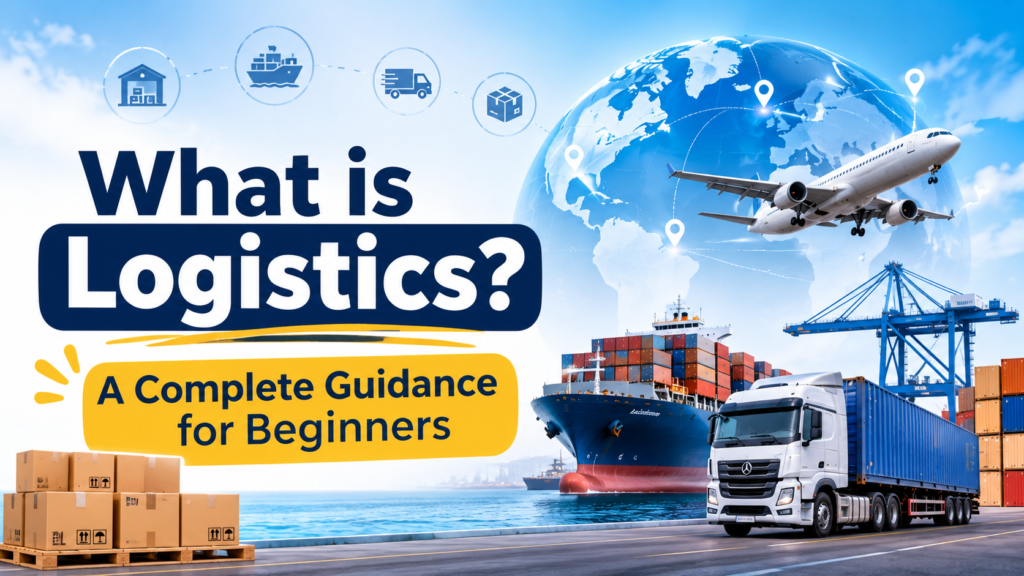
Logistics plays an important role in the modern business world. From delivering products ordered online to transporting goods between countries, logistics helps ensure that products reach the right place at the right time.
Today, businesses depend on efficient logistics operations to manage transportation, storage, inventory and product distribution. As international trade and e-commerce continue to develop, the importance of logistics is increasing across different industries.
For students interested in building a career in this field, understanding the basics of logistics is an important first step.
What Is Logistics?
Logistics is the process of planning, managing and controlling the movement and storage of goods, services and related information from their point of origin to their final destination.
In simple terms, logistics ensures that products are transported, stored and delivered efficiently.
For example, when a customer orders a product online, several logistics activities take place. The product is collected from a warehouse, packed, transported through a delivery network and finally delivered to the customer's address.
Importance of Logistics in Business
Logistics is essential for businesses because it helps manage the movement of products and materials.
Some important benefits include:
- Timely Delivery: Helps businesses deliver products to customers on time.
- Cost Management: Supports efficient transportation and storage planning.
- Inventory Control: Helps maintain suitable stock levels.
- Customer Satisfaction: Ensures products reach customers in good condition.
- Business Efficiency: Improves coordination between suppliers, warehouses and customers.
- International Trade: Supports the movement of goods between countries.
Major Activities in Logistics
1. Transportation Management
Transportation involves moving goods from one location to another using road, rail, air or sea transport.
2. Warehousing
Warehousing refers to storing products safely until they are needed for distribution or delivery.
3. Inventory Management
Inventory management involves monitoring and controlling the stock of goods available in a warehouse or business.
4. Order Processing
Order processing includes receiving customer orders, checking product availability, preparing items and arranging delivery.
5. Packaging and Distribution
Products are packed appropriately and distributed through suitable delivery channels.
6. Freight Forwarding
Freight forwarding involves coordinating the transportation of goods, particularly in domestic and international shipping.
Different Types of Logistics
- Inbound Logistics: Managing the movement of materials and products from suppliers to a business.
- Outbound Logistics: Managing the movement of finished products from a business to customers.
- Reverse Logistics: Handling returned, damaged or unwanted products.
- Third-Party Logistics (3PL): Using external service providers to manage logistics activities.
- International Logistics: Managing the movement of goods across international borders.
Skills Required for a Career in Logistics
Students interested in logistics should develop both technical and professional skills.
Important skills include:
- Communication and coordination
- Inventory and warehouse management
- Transportation planning
- Computer knowledge and MS Excel
- Understanding of logistics documentation
- Problem-solving and time management
- Knowledge of logistics software and ERP systems
Practical knowledge of tools such as SAP Material Management (SAP MM) can also be useful for understanding business purchasing and inventory processes.
Career Opportunities in Logistics
Logistics offers different career opportunities across transportation, warehousing, shipping, distribution and supply chain operations.
Some job roles include:
- Logistics Executive
- Warehouse Executive
- Inventory Controller
- Shipping Executive
- Freight Forwarding Executive
- Transportation Coordinator
- Supply Chain Assistant
- Import and Export Documentation Executive
The responsibilities and eligibility requirements vary depending on the employer and job role.
How Can Students Start a Career in Logistics?
Students can begin by learning the fundamentals of logistics and supply chain management through a relevant course or training programme.
They should focus on developing practical knowledge of transportation, warehousing, inventory management, documentation and computer applications.
Industrial exposure, internships, communication skills and interview preparation can also help students understand workplace requirements.
Conclusion
Logistics is an essential part of modern business operations. It connects suppliers, manufacturers, warehouses, distributors and customers through the efficient movement of goods.
Understanding logistics provides a foundation for exploring career opportunities in shipping, transportation, warehousing, inventory management and supply chain operations.
For students interested in this growing field, learning the fundamentals and developing relevant practical skills can be a valuable starting point.